The Grapes of Mild Outrage

Because I have class issues, I was interested in the closing exchange in Dan Chaon‘s recent interview with the Wall Street Journal. (I enjoyed his 2004 novel, You Remind Me of Me; haven’t read his new one, Await Your Reply)

In an interview, you spoke about the working class today being portrayed in fiction as “TV-watching, Twinkie-eating hicks.” You said you’re trying to show “a searching intellectual and emotional life in people who aren’t educated or rich.” Why don’t more novelists find inspiration in the working class?

There’s not as much contact between people of different social classes as we like to imagine. We’re not living in Oxford, Miss., where Faulkner was able to hang out with extremely rich and extremely poor people. Except in small towns, people are really divided. Most people who grow up in poor communities are not becoming writers. I have students who are the first generation to go to college. They may be great writers, but they want to improve their lives, and becoming a writer is probably not the best way to do that.

Seems like a simple enough point—we don’t have much fiction about working-class lives because there aren’t many working-class writers, and we don’t have many working-class writers because writing, when you’re hovering around the middle of the class ladder or two-thirds of the way down it, is a risky venture. (If you grew up that way and aspired to write, you were more likely to pursue skilled-tradesperson status as a journalist or PR professional. Easier to explain to the parents. I suppose journalism is off the table in that regard, now.) There are exceptions, of course, like Raymond Carver, Richard Price, Stuart Dybek, and Dorothy Allison. You know you’re an exception because you make a point of it: The first line of Allison’s official bio stresses that she is “the first child of a fifteen-year-old unwed mother who worked as a waitress.”

Perhaps it’s not so much that there’s a shortage today of good writers with working-class backgrounds—there’s a shortage of good writers from any background, after all—as a shortage of writing about work itself, and about what “working class” means today. Blame it on a hobbled American manufacturing base, or a fear that any writing about labor will become The Jungle; or, most likely, that work itself is a dull subject to write about. Regardless, American fiction about work is often fiction about finance and offices, as I’ve scribbled about before. Working-class jobs are more often things ripe for satire—like the carnivals in George Saunders‘ “CivilWarLand in Bad Decline” and Wells Tower‘s “On the Show.” Both are short stories, as if a book about getting your hands dirty couldn’t clock an eight hour read. Even a fine recent novel on the subject, Stewart O’Nan‘s Last Night at the Lobster, is strikingly slim, barely 150 pages. And though O’Nan has admirable respect for his characters, the overall tone is one of defeat—the Red Lobster in which the novel is set is about to close forever, the snow outside is miserable, and nobody cares to thinks much about the restaurant itself. If you think about it too hard, it’ll just remind you of the futility of life at the lower reaches of the corporate org chart, something the manager considers as he opens for the day:

If he never opens, he thinks, they can never close. It’s a kid’s wish. Whatever happens today, tomorrow the place will be a locked box like the Perkins up the road (and he’ll still have to show up in uniform for a few hours and hand out gift cards to the disappointed lunch crowd, as if this was his fault). For the last two months he’s been carefully managing down his inventory, so they’re low on everything fresh. Corporate will inventory what they can use and send it to Newington—the spoils of war. The rest, like the glass-eyed marlin, they’ll have hauled away. Probably gut the place, leave it to the mice and silverfish he’s fought to a draw for so long.

Why not just burn it to the ground? Whoever comes in is just going to want to build new anyway.

Update: A tipster directs me to this excellent four-way commentary about working-class writers from 2004 between Chaon, Susan Straight, John McNally, and the late Larry Brown. Among other things, the roundtable adds more recommended writers to the pool, including Kent Haruf, Tim Gautreaux, Pete Dexter, and Lynda Barry.

——

On an unrelated note—though books about music are often stories about failing to get paid properly for your efforts—I have a review of four books about the music industry in today’s Washington Post. It starts this way:

The music industry is supposedly dying, but it’s not going away quietly. A contentious debate this year over online radio royalties turned on who gets paid what in the pop economy. Congressional hearings on a proposed merger of Live Nation and Ticketmaster delved into whether one company would monopolize a corner of the concert business. Michael Jackson’s death not only prompted a massive sales boost for his recordings but also brought a rare moment of agreement between fans and critics on the musical icon’s legacy. As four new books make clear, these stories are just the latest iterations of decades-long arguments over how music gets played, heard, admired and paid for.

The four books are David Suisman‘s Selling Sounds (the one I liked best out of the batch), Greg Milner‘s Perfecting Sound Forever, Elijah Wald‘s How the Beatles Destroyed Rock ‘n’ Roll, and Greg Kot‘s Ripped.

Surfacing

I’m back from having spent the better part of a week in Toronto, where I heard Clay Shirky, Charlene Li, and lots of other smart people speak at my employer’s annual meeting. (It’s also where Candy Spelling was pitted against a Build-a-Bear Workshop, but that’s another matter.) I’ll get back into the usual swim of things shortly. (This has been the longest I’ve been separated from this blog since I started it, I think; it’s a strange feeling.) In the meantime, consider taking a look at the Southeast Review‘s Q&A with Donald Ray Pollock; D. G. Myersappreciation of Philip Roth‘s Goodbye Columbus on its 50th anniversary; and, perhaps because I’ve been exposed to too much celebrity journalism while biding my time in airport terminals yesterday, Miley Cyrusthoughts on The Catcher in the Rye.

Going Fourth

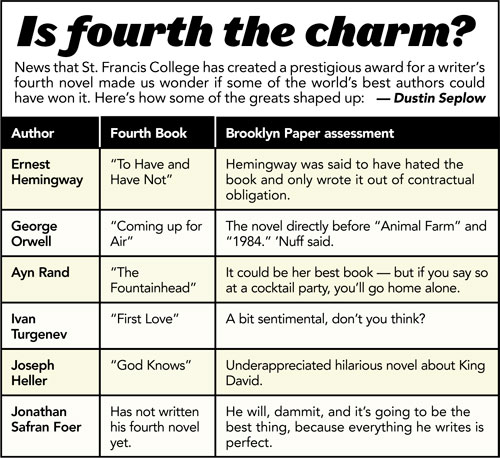
The Brooklyn Paper brings word of the St. Francis College Literary Prize, which awards $50,000 to the person who’s written the best fourth published work of fiction. (The story keeps saying “novel,” but the official guidelines are more general.) Up for the debut prize are Chris Abani, Aleksandar Hemon, Jim Krusoe, and Arthur Phillips. Phillips tells the paper what a fourth book means for a writer:

“The fourth novel certainly represents a psychological change in a career,” he said. “With the fourth book, I feel like I’m treated as a writer who has been around for a while — and who, if he is going to keep sticking around, is going to have to do something else to keep getting people’s attention.”

The paper also has a tongue-in-cheek chart on other famous fourth novels. A few more fourth fictions, while we’re at it (“checked” against Wikipedia, so inaccuracy may be pervasive):

Joyce Carol Oates, A Garden of Earthly Delights
Don DeLillo, Ratner’s Star
Paul Auster, The Locked Room
Russell Banks, Hamilton Stark
Ha Jin, Waiting
David Foster Wallace, Brief Interviews With Hideous Men
Michael Chabon, Werewolves in Their Youth
Jane Smiley, The Age of Grief

Not much to extrapolate from that list; there’s one of Jin’s best novels, but also DeLillo’s worst. The best that can perhaps be said is that by the time the fourth book rolls around you may be poised for some kind of breakthrough: Chabon’s fifth book was The Amazing Adventures of Kavalier & Clay. But plenty of writers I admire (Jhumpa Lahiri, Marilynne Robinson, Nathan Englander) haven’t even published their fourth books yet, so it’s not much of a benchmark for success or acclaim; as far as I can tell, Ben Marcus and Heidi Julavits haven’t hit book number four, and they got to help judge the award.

—-

On that note, I’m off for the better part of a week, working and traveling. Figure we’ll be dark here until next Thursday, though I’ll likely pop up on Twitter (@mathitak) from time to time.

The Scale of the Place

Documented because it’s a lovely passage, and because the other two cities I’ve lived in (D.C. and San Francisco), never seem to earn this kind of breathless observation:

“Thomas Kurton tells Thassa Amzwar to pick a meeting spot anywhere in the city. She laughs at the blank check. This city has forests in the northwest big enough to get lost in. To the south, black neighborhoods the size of Constantine that white people never enter. Convention centers with the look of fifties science-fiction space colonies. Warehouse districts full fo resale contraband peppered with refrigerated corpses. Cemeteries a hundred times the length of a soccer pitch, with gravestones in forty-one languages. There’s Chinatown, Greek Town, Bucktown, Boystown, Little Italy, Little Seoul, little Mexico, little Palestine, little Assyria…Two Arab neighborhoods—the southwest Muslims and the northwest Christians—where people from a dozen countries congregate to eat, recite Arabic poetry, and mock each other’s dialects.

She has my problem: too much possibility. A thousand parks, four hundred theaters, three dozen beaches, fifty colleges, fifteen bird sanctuaries, seven botanical gardens, two different zoos, and a glass-encased tropical jungle. Meet anywhere? The scientist doesn’t realize the scale of the place.”

Richard Powers, Generosity: An Enhancement

“Sound feminist or something grounds”

The New York Times‘ book blog, Paper Cuts, points to David Updike‘s eulogy for his father, John Updike, at a March tribute at the New York Public Library. David is, pretty much inevitably, an underrated writer, and his new story collection, Old Girlfriends, is worth tracking down. He’s inherited a lot of his dad’s themes but his stories don’t feel like mimickry, as if having that last name freed him instead of overwhelmed him. (The time-pressed might head straight for “Kinds of Love,” in which a man attends church with the woman with whom he’s having an affair.)

The nice thing about the Paper Cuts post is that it also points to a complete transcript [PDF] of the New York Public Library Tribute. The usual kindnesses were voiced by Knopf and New Yorker cohorts like Sonny Mehta, David Remnick, Roger Angell, and others. But Ann Goldstein, who edited Updike’s book reviews for the magazine, provided some of the most interesting commentary—it’s a window into how Updike came off as somebody openly willing to accept editing without having to change a damn thing. Goldstein reads a couple of examples of his reactions to edits:

From 1992: “My criticism inspires me with an increasing impatience. It seems simultaneously timid and reckless, a callow papering over of an invincible ignorance. Toward the end, on galley 12, I wearily brushed your suggested revisions aside, unable to rise to the occasion and finding my own phrasing more succinct and natural.” (laughter)

From 1989: “I noticed that somebody went through and deleted the Miss on I’m sure sound feminist or something grounds. It just seems a little discourteous to an elderly fellow like me to call her ‘Dillard,’ like some androgynous housekeeper or gruff governess. (laughter) The one beginning the paragraph on galley 9 seemed especially curt. It was our way in the days of Shawn to give all living female authors the courtesy of a Miss or Mrs.—Mrs. Spark, Miss Murdoch—but I am happy to go with the new ways if it seems important.”

Editing, for Updike, was “scraping off the fuzzballs”—something dutiful, fussy, perhaps even a little unnecessary (if you’re Updike, anyway). And though he liked the fussing, according to Goldstein he particularly loved it when a piece needed a quick turnaround—as any writer who’s written for a print publication knows, a signal that your copy won’t be mucked with much. “What fun, this sudden shuttle of proofs back and forth,” he’d tell Goldstein in those moments, “as though I live in the real world after all.”

What’s the Matter With Shermer? or, How John Hughes Turned Me Against Dave Eggers

My Gen-X brain is slowly showing signs of memory loss, so I can’t recall exactly where I saw every film by the late John Hughes. But I’m pretty sure I caught both Ferris Bueller’s Day Off and The Breakfast Club in a movie theater in Forest Park, Illinois, not far from my hometown of Lyons. The location was meaningful to me. Forest Park is about 20-odd miles south of Northbrook—Hughes’ hometown, the filming location of much of his best-loved films, and the stand-in for the mythical town of Shermer, his upscale Yoknapatawpha of teenage angst.

Ferris Bueller’s Day Off is famous for being a kind of accidental tourism film for Chicago; the Art Institute of Chicago, in particular, never had it so good onscreen. For me, it also served as a tourism film for Chicago’s North Shore, home to some very nice houses (though the Bueller home in the film is in California) and some very good schools. Bueller’s mad dash home at the end of the movie through the backyards of Shermer required huffing and puffing through big, broad lawns, leaping hedges every hundred paces, occasionally cutting through streets that were sometimes politely interrupted by traffic. If I were to attempt the same trick at the time, I’d have to avoid the gravel trucks leaving the quarry a block away and jump chain-link fences (and cranky dogs) every 20 feet.

That’s a long way of saying that Bueller was one of my first introductions to class distinctions. Though Bueller and his friends shared some of the same geographical touchstones I did (I liked going to Cubs games and the Art Institute too), there was an ocean-wide gap between their lives and mine. Though Hughes films are celebrations of the teenage rebel, those rebels all achieve closure by embracing the upscale existence they spend their lives in anyhow. Bueller is going go back to his high school and listen to Ben Stein drone; Molly Ringwald‘s characters in Sixteen Candles and Pretty in Pink land cute, upper-middle-class guys, despite her other-side-of-the-tracks mala fides in the latter; Judd Nelson‘s badass rebel in The Breakfast Club landed Molly Ringwald, in that film the epitome of North Shore comfort and assurance. Hughes films are mostly about finding love, but they’re also a little about finding the shortcut to upward social mobility.

It was, for an attendee of a high-school in a blue-collar suburb that had aggressively resisted any tax increases for schools in decades, a little grating. (None of which is meant to paint my adolescence, or where I grew up, as degraded or miserable; Chicago suburbs get economically worse the farther south you go, and I was pinned somewhere in middle. I did much better than cartons of cigarettes on Christmas, I got to go to a good college, and the promise of upward social mobility has worked out just fine for me.) After about ten years or so, John Hughes films and youth spent in a UAW household installed a few prejudices in me. So by 2000, when Dave Eggers published his memoir, A Heartbreaking Work of Staggering Genius, my brief on the book wasn’t, “Here’s something by a guy who used to work at the same paper I do,” but “Here’s something by a guy who grew up in Lake Forest.” My initial reaction to the very existence of the book was active dislike.

It seems a little silly, now—after all, plenty of my favorite writers were raised in perfectly nice homes more than a few rungs up the class ladder than I was. Would I have resented Michael Chabon for growing up in Columbia, Maryland, if I grew up in one of that town’s scruffier neighbors? At any rate, the only evidence of class resentment I can detect in my review of Staggering Genius is my urge to stress that Eggers lived in “Lake Forest, an affluent Chicago suburb.” I’m confident that my disappointment in the book was more a function of its contents than the feelings I brought to it, though it can be difficult for a reviewer to separate the two; I’m also certain that And You Shall Know Our Velocity! is an awful book because it is an awful book, not awful because somebody who grew up in Lake Forest wrote it.

If my prejudices were still deep-seated, I could keep myself busy for a while reading nothing but books about working-class families in the Midwest. That would make me sick of my own existence fairly quickly, though; one of the main pleasures of reading fiction is that it introduces you to lives you couldn’t experience, haven’t experienced. Those old Hughesian resentments haven’t reduced my admiration for Ward Just, who’s as North Shore as they come. The goal is to avoid thinking of people—as the poignant, fist-pumping note at the end of The Breakfast Club put it—“in the simplest terms, in the most convenient definitions.” If I’m being honest, I’ll concede that Hughes probably taught me a little bit about that too.

Links: Installment Plan

In the Wall Street Journal, Lee Siegel argues that we are no longer living in an “episodic” era for fiction, stories more about events than transformations featuring Huck Finn and Augie March. We are now, somewhat unfortunately, living in the “narrative” era, where we crave closure and emotional growth in our characters. This is, of course, all 9/11’s fault. Arguments to contrary will abound, I’m sure—hasn’t popular fiction always been “narrative,” and aren’t most satirical fiction writers today (George Saunders, etc) dealing in “episodic” fiction, as comic writers always have? Somebody organize a conference!

Speaking of: The International Conference of Mark Twain Studies is going on now in Elmira, New York. According to the video, discussions of cats and studious beard grooming are on offer.

A lovely collection of Rockwell Kent‘s illustrations for Moby-Dick.

Constance Fenimore Woolson sold more books in her time than her would-be beloved, Henry James, but James got global fame and a bust in the National Portrait Gallery; Woolson gets a plaque on Mackinac Island.

The Bud Billikin parade is this weekend, which may mean nothing to anybody reading this outside of Chicago. But it’s a big deal there—a South Side to-do launched to get the kids excited to go back to school, and the brainchild of novelist Willard Motley, considered “the most prolific novelist associated with the concluding years of the Black Chicago Renaissance.”

Rick Moody listens to music while writing, but no lyrics please: “He has a fondness for ‘experimental or serious music that doesn’t have lyrics.’ For him, this includes music by La Monte Young, Morton Feldman, Meredith Monk, Steve Reich, Arthur Russell and Rhys Chatham.”

In addition to writing a new novel and a horror movie, Michael Cunningham is working on the screenplay to a Dusty Springfield biopic.

Larry McMurtry is pretty much done: “I’m about at the end of it. I can write certain things. I don’t think I can write fiction any more. I think I’ve used it up over 30 novels. That’s a lot of novels.”

Budd Schulberg—novelist (What Makes Sammy Run?), screenwriter (On the Waterfront), and Papa’s sparring partner—died this week at 95.

And PopMatters draws a few interesting connections between manga pioneer Yoshihiro Tatsumi and Raymond Carver.

Slow Going

The Chicago Reader catches up with Audrey Niffenegger, who’ll be getting plenty of attention in the coming months—the film version of her debut novel, The Time Traveler’s Wife, comes out August 14, and her follow-up, Her Fearful Symmetry arrives in September. Niffenegger is a Famous Author now, but the article concentrates on her lovely, less blockbuster work as a visual artist. (If you’re in Chicago at the moment, you can see some of the pages of her illustrated story “The Night Bookmobile” at Printworks Gallery.)

It’s been six years between novels for Niffenegger, and she tells the Reader that her bestseller status had a role in that:

“When I was writing my first novel I was alone with it,” she says. “For my second novel I had the benefit of other people’s expertise”—an agent and editors—”but it can make the work go slower because I . . . question myself more as I go along. I know I will be hearing from readers if I get it wrong.”

How much has it slowed her down? She says that she’s currently 20 pages into her next novel, The Chinchilla Girl in Exile—a work that she’s been writing since at least 2006. She told Writer Unboxed back then, “It’s about a nine-year-old girl who has hypertrichosis, which is a hereditary disorder in which hair grows all over one’s body and face; my character, Lizzie, looks like a junior werewolf. I’m very fond of her, she’s plucky.”

Workshop Prose

My in-flight companion during the past long weekend was a galley of a forthcoming biography of Raymond Carver. I’ll scribble more about that when the time comes, I’m sure (it’s out in November), but for now I’ll say that one of the many striking things about Carver’s life was how much traveling he did as he was launching his career—from college to college, program to program, anything that was going to allow him to stabilize his always-wrecked finances and give him a quiet space to write. The shame of his lost years is how much of his time was squandered on drinking instead of working; in Iowa City he and John Cheever timed their mornings to show up at the liquor store just as it opened in the morning.

Still, those programs were critical to him as a writer. Well before Gordon Lish allegedly “made” him, Carver worked hard under the tutelage of Grendel author John Gardner at Chico State University, where he learned the importance of revising, revising, and revising some more. Years later he’d put some of that advice into a letter to his daughter: “When something feels complex or complicated to you, write it out carefully and thoughtfully, several different times if necessary, until it flows smoothly and expresses exactly what you want it to communicate and nothing else.” Sounds like a no-brainer—you read it and wonder why we need writing classes at all, practically everything you need to know is in that one sentence. But for Carver that simple guidance was hard-earned. And of course, it’s advice that’s damn hard to execute.

Carver is of course now synonymous with “workshop prose”—once his reputation was made in the 80s, so many aspiring writers were seduced by the simplicity of his writing that they thought it was simply achieved, and they signed up with MFA programs en masse to achieve it. I suspect that much of this is covered in a recent book I haven’t read, Mark McGurl‘s The Program Era, but as a shorter defense of the workshop, I liked the comments by Telex From Cuba author Rachel Kushner. She’s teaching fiction for the first time, and talked to the National Post about it:

There’s this argument — I mean, you see it percolating up in the Amazon review comments — that, ‘Oh, this reads like workshop prose.’ But the idea of the workshop is not totally new. Flannery O’Connor took a workshop. Nabokov was Thomas Pynchon’s teacher. So at least in the United States there’s a real tradition of this. And most of what I’ve learned as a writer I learned after the workshop. But the workshop allowed me to place myself in a context of peers and try to assess with a colder eye wether or not I should keep going.

If “workshop prose” is showing up in Amazon review comments, it’s probably time to officially designate the term a tired cliche and move on.

Links: Very Strange or Very Famous

What kind of writer was Raymond Carver? As the new Library of America collection of his work shows, it’s complicated, largely for reasons having to do with Gordon Lish.

Related: “When Novelists Sober Up”

Portnoy: Gay?

Publishers don’t like to publish short story collections in general unless they are VERY high concept or by someone very strange or very famous or Indian.”

Alice Hoffman on how Fahrenheit 451 rejuvenated her.

A musical about the last days of Ernest Hemingway (“complete with a cheery song about how to load a gun”) stinks, and it’s closing early.

William Kennedy is finishing his first novel since 2002’s Roscoe; it’ll be an addition to the Albany Cycle.

Amitav Ghosh would love to hang out more with his neighbor Jhumpa Lahiri, but she tends to be busy.

An inventive approach to book shelving. But heaven knows where my Robot Chicken DVDs would fit in this scheme.

George Pelecanos‘ UK publisher sure is pushing the Wire angle hard with the cover of his new novel, The Way Home. He’s so popular in England that they let him open for the Pogues:

On that note, I’ll be taking some time off from the blog for a few days, enjoying some time off the grid, listening to music, and spending a little more time reading books than chattering about them. We’ll get this thing plugged back in around the middle of next week.