“Gatekeeper”: Still Not a Dirty Word

One of my first gigs as a freelance writer was covering concerts for the East Bay Express, an alternative weekly in Berkeley, California. Mostly I attended folk shows or enormo-dome concerts nobody else wanted to write about, but every so often I’d get assigned to go to 924 Gilman, the warehouse space at the center of the East Bay punk scene that spawned Green Day and the like. I had fun at the shows and got a lot out of the music, but I was still there more as a reporter than a fan. So I took it a little personally when I showed up one evening and noticed that somebody had spray-painted something on the wall behind the stage:

MEDIA OUT OF MY PUNK ROCK

The message definitely wasn’t meant for me and my 450-word squibs in the back of the Express arts pages; it’s just that it was 1996, 1997, and the scene was still sensitive at how it had been commodified. (And somebody was probably mad at Gina Arnold, the paper’s lead rock critic at the time; back then, somebody always seemed to be.) Still, I was sensitive to the accusation, so I brought the graffiti up with a friend, voicing some youthful anxiety about being an interloper, cultural appropriation, etc. She cut me off: “Punk rock is a medium.”

In other words, the bands at 924 Gilman were trying to make a coherent statement about the world as much my newspaper was. We could debate whose worldview was more informed and legitimate, but one didn’t automatically earn the high ground over the other. That sentence popped into my head reading a post by Peter Stothard, editor of the Times Literary Supplement, describing a recent panel about the future of book reviewing that included Stothard, Michael Dirda, Jessa Crispin, Steve Wasserman, and Sam Tanenhaus. At some point the conversation turned to the role that Web sites, blogs, and/or newspapers have as gatekeepers:

Another issue was whether we should we be ‘gate-keepers’ for the literary culture that we like, letting in what we considered of quality and worth and excluding what we did not? Jessa Crispin does not want Bookslut to be a gatekeeper or anyone else to be one either. It seemed desirable to me that another word for the principle of gate-keeping might be desirable for the rest of the afternoon.

The question baffles me a little, because whether Crispin, Stothard, or anybody else wants to be a gatekeeper or not, it’s the gig they’ve signed up for: Bookslut, like any book publication, online or otherwise, is in the business of picking and choosing what stories it feels are most important to the audience it would most like to cultivate. To behave otherwise is madness—letting any old thing in and deeming it worthy of attention. When people get mad at the word “gatekeeper,” I suspect it’s because they imagine a cranky troll minding a very narrow gate. Or the troll is easily paid off by some minion of the publishing industry. In an essay published on the Washington Post‘s Web site last year, Crispin dismissed newspaper book reviews as echo chambers, talking about the same damn five or six big books every week: “But most of the reviews are dead weight anyway, creating nationwide echo effect: ‘That Junot Diaz book sure is good, don’t you think so?’ ‘Oh yes, certainly.’ ‘And I absolutely think the world needs more superhero-derivative adolescent-boy sagas, alongside the occasional magical realism written by white male Ivy League graduates, don’t you?’ ‘Oh yes, yes. Quite right.'”

Note the prissy, tea-at-two tone of the conversation that Crispin imagines: Her complaint isn’t so much about “gatekeeping” but with thoughtless cultural elitism and a reflexive embrace of what’s new and popular. Those are reasonable complaints to have about literary culture and book reviews, but framing the discussion around the word “gatekeeper” doesn’t get a debate started about those issues. The bookers at 924 Gilman did just as much selective picking and choosing as the booking agents for those enormo-dome shows; they just took a smaller fee, if they took a fee at all. And Bookslut does just as much gatekeeping as the Washington Post, which is what Bookslut’s readers prize about it. Stothard writes that he’s looking for a different word than “gatekeeper” to define the issue, but even if he landed on one that’s more polite and agreeable (“curator”?), it wouldn’t address the bigger issues that Crispin addresses.

This Old House

A few years ago I spent a long weekend in San Antonio, which I quickly learned is a difficult city in which to spend a long weekend without a car. I visited the Alamo, twice, and did the river-boat tour, twice; eventually I broke down, violated the tourist’s code, and went to go see a movie. (March of the Penguins, I think; it was miserably hot in San Antonio too.) One evening, on the way to dinner, I happened past a shed-like building that turned out to be the home of O. Henry from 1895 to 1896. Various signs marked the spot as the Henry home, but either due to its tiny size or lack of interest, nobody staffs the site for visitors. Stephen J. Gertz, who had a similar experience in the city, writes in Book Patrol about a recent visit to the Henry house:

There is welcome sign inviting visitors but in a strange plot twist I discovered that when you push the buzzer, ostensibly to gain entry, one is instead treated to a recording, a disembodied voice narrating the story of the house and O. Henry’s occupancy. In a further plot twist, no online biography of O. Henry makes any mention whatsoever of his residence in San Antonio; the only information on O. Henry in San Antonio is found on San Antonio-related sites and there are factual conflicts. Houston, Austin, and San Antonio appear to be locked in a struggle for bragging rights.

From there Gertz calls to have the Henry home moved from its perch on downtown’s outskirts to Alamo Plaza. Good idea: It would precisely double the number of interesting things to see there. For what it’s worth, Henry (born William Sydney Porter) didn’t seem to think too much of the place either. His short story “The Higher Abdication” describes Curly, a drifter stuck in the city for a while:

San Antonio puzzled and disturbed him. Three days he had been a non- paying guest of the town, having dropped off there from a box car of an I. & G.N. freight, because Greaser Johnny had told him in Des Moines that the Alamo City was manna fallen, gathered, cooked, and served free with cream and sugar. Curly had found the tip partly a good one. There was hospitality in plenty of a careless, liberal, irregular sort. But the town itself was a weight upon his spirits after his experience with the rushing, business-like, systematised cities of the North and East. Here he was often flung a dollar, but too frequently a good-natured kick would follow it. Once a band of hilarious cowboys had roped him on Military Plaza and dragged him across the black soil until no respectable rag-bag would have stood sponsor for his clothes. The winding, doubling streets, leading nowhere, bewildered him. And then there was a little river, crooked as a pot-hook, that crawled through the middle of the town, crossed by a hundred little bridges so nearly alike that they got on Curly’s nerves. And the last bartender wore a number nine shoe.

Links: Brought to You by Dell and Folgers Coffee

Earlier this week the FTC released new guidelines on how bloggers must disclose their relationships with commercial entities. I haven’t spent much time thinking about this—unlike smart people who have—mainly because I suspect any battle between the gummint and bloggers will attack women and children first. Relatively speaking, me and my modest stack of advance reader’s copies aren’t worth anybody’s attention and trouble. I’ve always considered ARCs as a tool to do my job, not some great prize; I receive them, but, like editors at newspaper book reviews, I feel no particular obligation to review them, acknowledge their existence, or announce their provenance if I do get around to mentioning them.

George Saunders reports from a homeless tent city in Fresno, California.

Jane Smiley discusses her first novel for young adults, The Georges and the Jewels.

Sherman Alexie
: “If I had been talking about drowning polar bears [instead of the Kindle], people would have been weeping with me. But nobody recognizes that a bookstore or library can also be a drowning polar bear. And right now in this country, magazines, newspapers, and bookstores are drowning polar bears.

Paul Auster laments the death of independent bookstores in New York: “In my own city of New York, so many superb bookstores have gone out of business in the past years that the epidemic has reached tragic proportions. The Eighth Street Bookstore, the grand literary emporium of my youth, has been a shoe store for more than two decades now. The Gotham Book Mart (‘Wise Men Fish Here’), the home of the James Joyce Society, the home in exile for André Breton and other French Surrealists during World War II, closed its doors recently. Books and Company is gone. Endicott Books is gone. Coliseum Books is gone.”

A personal consideration of Raymond Carver along with some thoughts on Lishification, and a profile of his widow, Tess Gallagher.

A cache of Mark Twain‘s papers, including letters he wrote during the last months of his life, goes up for auction later this month.

Jonathan Lethem on his new novel, Chronic City: “I had to figure out, ok what should I be writing? I thought, the answer is always, I should write the thing that if I don’t write it, it wouldn’t exist… Maybe I could write a realistic social epic of the Upper East Side; it’s possible that I could do that. I feel that I’ve acquired a lot of those tools and inclinations, but to merge it with the dream-life material, I feel that’s my special task.”

Chicago gets a literary hall of fame.

Bad Bet

Narrative magazine’s Web site has an essay by Joyce Carol Oates on her literary mentors—a lengthy piece, considering her argument is that she’s had few such people in her life. (Even her first husband, Raymond Smith, read almost none of her fiction.) She’s had childhood guides, yes, like her grandmother; and she’s had sparring partners like John Gardner, with whom she had extended debates in the 70s about whether writing fiction is or should be moral. But people who guided her writing and career with a mind to support and improve it? Nary a one—and though she doesn’t quite come out and say it, such is the fate of many writers who grow up in hardscrabble communities, where literary support systems are hard to come by. You’re not sui generis because you’re arrogant; you’re that way because there’s nobody around to set a path for you.

To that end Oates gets in an interesting story about her relationship with Donald Barthelme, who appears in this anecdote to eagerly flay himself over sales. The suggestion being that this is what you get when you care too much about what others think:

No sooner had my husband and I been welcomed into the Barthelmes’ brownstone apartment—no sooner had I congratulated Don on what I’d believed to be the very positive reviews and bestseller status of his new book of stories, Amateurs —than he corrected me with a sneering smile, informing me that Amateurs wasn’t a bestseller, and that no book of his had ever been a bestseller; his book sales were “nothing like” mine; if I doubted this, we could make a bet—for $100—and check the facts. Quickly I backed down, I declined the bet—no doubt in my usual embarrassed and conciliatory way, hoping to change the subject.

But Don wasn’t in the mood to change the subject just yet. To everyone’s embarrassment—Ray’s, mine, his wife’s—Don picked up a phone receiver, dialed a number, and handed the receiver to me with the request to speak to his editor—he’d called Roger Straus at Farrar, Straus & Giroux—and ask if in fact Donald Barthelme had ever had a bestseller; and so, trying to fall in with the joke, which seemed to me to have gone a little further than necessary, I asked Roger Straus—whom I didn’t know, had scarcely heard of at this time in my life—if Don had ever had a bestseller, and was told no, he had not.

Plaintively I asked, “He hasn’t? Not ever? I thought . . .”

The individual at the other end of the line, whom I would meet years later, the legendary Roger Straus of one of the most distinguished publishing firms in New York, said coolly, “No. He has not. Put Don on the phone, please, I want to talk to him.”

(h/t Edan Lepucki)

Improved U.S.-China (Lit) Relations

Scholars at three universities—Iowa State University, Arizona State University, and Sichuan University in China—recently launched Project Yao, a database of American literature translated into Chinese. ASU English professor Joe Lockard explains the appeal of the idea:

“Why, for example, are there so many translations of Longfellow’s ‘Song of Hiawatha’ into Chinese? Since 1930 there have been five Hiawatha translations. What do such translations inform us about the global representation of native peoples in the United States?

“Have there been more recent translations of the work of Native American authors into Chinese? Is the translation economy shifting to acknowledge ethnic self-representation? These are the sorts of questions that one can begin to address by using the Project Yao database.”

The database only includes works of American literature published before 1920, so it’s no guide for what contemporary American writers are being read in China. And the database only covers translations published in China from 1999 on, so it’s not yet a very panoramic snapshot of how the country’s changing political climate affected what got translated. But it’s a fascinating start, and if nothing else shows how the hunger for the likes of Jack London and Theodore Dreiser remains undiminished. (Surprisingly, only one work of Mark Twain‘s appears in the database, and even then it’s just a short story.)

According to a 2007 interview with Ha Jin in Guernica, American writers apparently fell in and out of favor rapidly. So when a work by Ernest Hemingway became available, he took advantage of it:

When I was an undergrad in my junior year suddenly American literature became very popular. But at the time many of the books were not available. One book, The Old Man and the Sea, because it was a short book and was written in clear, very lucid, English, had a bilingual edition made just for the English students in China, so a lot of people knew that book. As a result, Chinese readers talked about Hemingway. In that story there’s a fight between a man and a shark. You can conquer but not defeat a man. We were taught a lot of Marxist morals. But this kind of Hemingway American mentality, at least as expressed in that small novel, was fresh to the young people at the time, so we all somehow believed in it. But when I was working on The Bridegroom, I was much older by then, I really wanted to give some comic touches instead of tragic. That’s why I made the narrator unable to remember Hemingway’s name.

Foreign Correspondence

Writing in the Huffington Post, debut novelist Ru Freeman discusses American readers’ bad habit of turning a fiction writer of foreign descent into a spokesperson for an entire culture. Freeman is Sri Lankan, and she’s noticed how a lot of people reflexively peg her book as a statement about her homeland:

Why is it that when a book is written by a South Asian author and is set in a South Asian country, the reading public expects a dysfunctional stew of communal warfare, misogyny, and abject poverty? Why is it that even when the book is not a last-word on an entire culture but, like any “American” fiction, a story about a particular family, set of circumstances and time period, it is taken to be a definitive statement on the entire culture? I get an email a day from someone who loves my book, which I appreciate – keep them coming! – but whose missive ends too often with some variation of “Thank you for highlighting the sad status of women in Sri Lanka. I’m so glad I live in the United States where I take so much for granted.” No, no, no. This is not a book about The Status of Women in Sri Lanka.

It’s a fair point—foreign-born or “ethnic” writers (to use Freeman’s quotes) tend to be celebrated for bringing the news about their native culture as much as they are for their talents. That doesn’t diminish those talents, or at least it shouldn’t—Jhumpa Lahiri, Maxine Hong Kingston, Edwidge Danticat, and Ha Jin are important writers in any event. But the expectation of spokesperson-hood is built into those writers, either as a function of readers’ presumptiousness or—to no small degree—a nudge from the publisher. The promotional patter for Freeman’s novel, A Disobedient Girl, exacerbates the very problem she’s agitating against:

Set against the volatile events of the last forty years of Sri Lankan history, A Disobedient Girl traces the lives of three characters whose interwoven fates and histories force them to answer life’s most difficult questions…. A Disobedient Girl is a compelling exploration of personal desire set against the volatile backdrop of class and prejudice, as three women journey toward their future, united by a shared history but separated by different fates.

I haven’t read the novel, but if all I had to go by was Simon & Schuster, I’d figure I was in for a big, broad historical novel about The Status of Women in Sri Lanka.

That’s not to say that Freeman is being disingenuous, just that It’s not unusual for ethnic writers get jacket copy that emphasize that all-encompassing spokesperson-ness. Danticat’s Breath, Eyes, Memory, for instance, “evokes the wonder, terror and heartache of her native Haiti—and the enduring strength of Haiti’s women—with a vibrant imagery and narrative grace that bears witness to her people’s suffering and courage.” Daniyal Mueenuddin‘s In Other Rooms, Other Wonders is “a vivid portrait of feudal Pakistan, describing the advantages and constraints of social station, the dissolution of old ways, and the shock of change.” Manil Suri’s The Death of Vishnu is “suffused with Hindu mythology and the exuberance of Bombay cinema” and becomes “a metaphor for the social and religious divisions of contemporary India.” Never mind matters of style and storytelling—the books are sold as field reports. A decade or so of readers confronting that on the bookstore shelves, and condescending thank-you letters about how powerfully you’ve explained a whole country practically become an occupational hazard.

Pitch-Shifting With Zoe Heller

Zoe Heller‘s latest novel, The Believers, is an impressive feat of tonal control as much as it’s one of plot and characterization. The book follows the lives of the Litvinoff family after its patriarch, Joel, suffers a stroke, throwing a spotlight on how the event challenges each member’s received wisdom about religion, politics, and the basic matters of getting through life. Heller’s strategy is as old as the Book of Job and new as The Corrections: Poke a few holes in that received wisdom and see what spills out. Audrey, Joel’s wife, is an insufferable know-it-all as the novel begins and grows into a downright intolerable harridan who takes joy in emotionally brutalizing whomever she comes into contact with; her daughter Karla increasingly flagellates herself over her weight and infertility; her other daughter, Rosa, undergoes a crisis of conscience thanks to her growing interest in Orthodox Judaism; and her adopted son, Lenny, remains an addict whose minor role in the novel reflects his minor role in life, batted around by others and only half-aware of what’s going on.

Heller’s message is clear, and her calibrations can be obvious; in a lesser writer’s hands, the book becomes a simple lecture on the perils of being hard-headed. One way she avoids that fate is by complicating her characters—Audrey is vicious, but she’s not always wrong, and a few of her targets deserve what they get. But another key to the novel’s success is Heller’s control of the pace of the story, the way that she can accelerate the narrative in it’s more frenzied moments and (the tougher trick) ease the reader into a lower gear when describing a moments of emotional peace. The latter scenes are nearly always the ones focused on Rosa, as she becomes drawn deeper into Judaism. Her faith is new to her, and when Heller studies her emotions the narrative isn’t spiked with the emotional chaos that rattles around in everybody else’s head. For instance:

Rosa looked around at the crowd of Orthodox Jews who were waiting with her for the bus. Almost all of the men were wearing dark suits and oversize black fedoras. The female portion of the group had a slightly looser but no less distinctive dress code that involved long skirts, wigs, and an aggressively frumpy layering of shirts and sweaters and cardigans. Rosa felt exposed and slightly flustered to be consorting in broad daylight with such ostentatiously Jewish Jews. She wondered anxiously if any of the pedestrians walking by on Fifth Avenue mistook her for one of this clan. She turned and considered her reflection in a shop window. The outfit she had cobbled together for this occasion was modest enough to daunt the most lascivious gaze. But, she could see now, she was in little danger of passing for an authentic Orthodox woman. She looked like nothing so much as a mad Victorian governess trying to hide a skin disease.

The paragraph ends with a joke, a slight dig on Rosa’s appearance, but it’s hardly a wound. She’s allowed to keep her dignity, and the words used to describe her emotions (“exposed,” “flustered”) are largely clinical. Compare that to how she describes Karla in a moment when she herself is feeling exposed and flustered:

In the restroom off the hospital lobby, she took a long punitive look at her reflection in the mirror. Her nose was swollen and glowing, a joke-store accessory. Her blouse had ridden up, revealing several intersecting lines of pink and white crenellation where her waistband cut into her belly. She let out a small groan of despair. She had cried—cried about being fat—in front of a stranger.

Heller doesn’t spend the novel mocking Karla—indeed, she’s one of its more respectable characters—but she makes clear that Karla’s self-loathing is deep. She describes it forcefully, setting Karla’s despair off between em-dashes and putting a magnifying glass on her flaws. Rosa’s emotions occur at a distance, something she acknowledges in the midst of her more prominent concerns about faith. Those distinctions will matter once the conflicts increase in the final chapters of the novel, and it also controls the reader to an extent: We’re invited to think about Rosa’s concerns but to feel everybody else’s.

Heller told the New York Times earlier this year that she labored over her treatment of Rosa:

For Ms. Heller, the most difficult part of the novel was depicting Rosa’s slow religious conversion, particularly since the character is so intellectually fastidious. As an atheist, she said, she bent over backward to avoid coming off as condescending or snooty, and her portrait of Orthodox believers is both sensitive and sympathetic. If anything, she said, “I erred on the side of giving them an easy ride.”

It’s true that Rosa’s character emerges as among the more heroic in the novel, but that’s not because of any deliberate sanctioning of Orthodox Judaism on Heller’s part. What Heller so deftly captures are the degrees to which each character succumbs to their feeling. When Rosa appears she’s at the kind of peace her mother and siblings could only pray for (if they were praying types), and Heller has smartly marshaled the words that show it. She doesn’t give Rosa an “easy ride”; her ride just goes down easier.

Links: Sad State of Affairs

Happy Friday! Here’s a guide to depressing novels.

Jonathan Lethem recalls his longtime relationship with the works of Philip K. Dick (via i09).

NYRB Classics editor Edwin Frank talks with Washington City Paper about its reissue of Don Carpenter‘s excellent debut novel, Hard Rain Falling.

The Road director John Hillcoat is looking to film The Wettest County in the World, Matt Bondurant‘s bracing 2008 novel about Virginia bootleggers.

Newark, New Jersey, makes its pitch to be a “major cultural capital” by landing a major poetry conference. Jayne Anne Phillips approves.

Meanwhile in Newark, Amiri Baraka turns 75.

Flavorwire has a Q&A with Joyce Carol Oates, who reveals that she’s working on a memoir titled The Seige: A Widow’s First Six Months.

Liked the book? Buy the handbag.

Elmore Leonard will receive PEN USA’s lifetime achievement award.

Why Vladimir Nabokov‘s unfinished novel The Original of Laura won’t be available as an e-book.

The case for Alice McDermott as an important Catholic novelist.

James Ellroy: “I distrust people who do not err on the side of action. And there’s a distinction between being conflicted and being ambivalent. Ambivalence connotes wishy-washiness, being conflicted connotes a clash of dramatic choices. And so I despise the idea of shades of grey or ambiguity standing as ultimate moral value or literary value.

Cover Story

Back in July, San Francisco-based novelist Matt Stewart began Twittering the contents of his novel The French Revolution. The effort not only got him some blog heat but a book deal as well: Last month Soft Skull Press announced that it will publish Stewart’s novel on Bastille Day, July 14, 2010.

That’s a way’s off, but the work getting the book ready for publication is happening now, and the task of designing the cover falls to Goodloe Byron, an artist who splits his time in Washington, D.C. and the Maryland suburbs. Byron has a number of Soft Skull covers to his credit—I’m particularly fond of his work on Matthew Sharpe‘s 2007 New World satire, Jamestown—and he was willing to open up his portfolio to show his progress on the novel so far. (Disclosure: I’ve worked with Byron in the past, editing a book review he wrote for Washington City Paper.)

“There’s a playfulness, but with an edge, to what he does that struck me as the right tone to accompany the humor and energy of Matt’s writing,” says Soft Skull editorial director Denise Oswald of Byron’s work. And though Byron stresses that has no formal artistic training and lacks many of the resources available to designers at larger houses, those are assets to Oswald’s mind. “Every cover is different and every artist is different,” she says. “I think Goodloe tends to riff on a lot of different ideas, so he sent me way more treatments than I might have expected. I think that’s particular to his process. The flipside is that we needed the cover on a much shorter schedule than normal and it prompted us to move quickly through a lot of different approaches and discard things that weren’t immediately working for us, rather than ruminate on one particular direction to follow or whether a promising idea that wasn’t working could be fixed.”

Authors aren’t always given much of an opportunity to collaborate on cover concepts—a fact that recently backfired in the case of the paperback of Justine Larbalestier‘s novel Liar. But Stewart was included in the process and encouraged to submit examples of what he liked. “I went back and looked at lists of ‘best covers’ and they tended to be a simple but interesting image, so I wanted something simple that says it all—and pops,” he says. “We’re trying to encapsulate some pretty big themes and complex storylines here, but two critical elements are 1) a San Francisco epic and 2) loosely structured on the historical French Revolution. The Golden Gate Bridge and the guillotine are the natural symbols for those, and combining them in an interesting way is absolutely awesome.” (Incidentally, Stewart is a D.C.-area native; his father is author David O. Stewart.)

Byron’s cover concepts are below, along with his comments. Oswald emphasizes that the cover is still very much a work in progress. “After the editor, author, and designer are settled on a direction, the cover has to fly by the publisher, publicity, marketing, the sales force, and to a certain extent the booksellers,” she says. “If anyone along the line raises serious reservations that ring true to us, then we could find ourselves back at square one.” I’ll pick up the story again once The French Revolution is published; here’s how the story looks now.

fr1

It is always very risky to represent the characters directly, especially if you’re going to show them to the author. Certain kinds of images and illustrations are fine, but the moment you start to have more than one character on a cover the image seems to become less of an evocation of the style of the book than a direct representation of the characters and events, which authors are very touchy about (understandably). So this one was immediately put on the back burner to see if Matt would warm up to it.

fr2

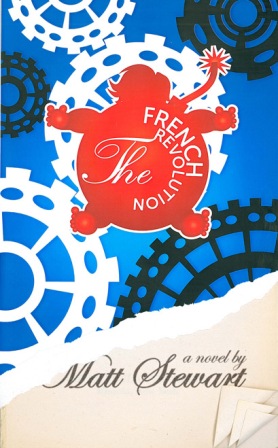
I stopped working on the first drawing fairly confident that they would reject it or provide me with some notes that would require starting over. Denise wanted me to illustrate the cover, something akin to Confederacy of Dunces, but I decided at this point that I would just send her totally random ideas so as to be well diversified in the event that thought the drawing quality and adherence to detail was awful. In the book, the progenitor of the revolution is an extraordinarily large woman, which I had not represented well in my first illustration, as it seemed like it would have been difficult to do it in that style without mocking her obesity. The children are also mixed race, which I didn’t bother representing very well either. So i thought, well I should do something that shows I read the book. Then I did this delightfully pudgy red thing. It was only then that I thought, you know, if I add a fuse to that thing and make it a bomb then maybe we’re good to go. As it turns out, both Denise and Matt were charmed by the illustration, but they didn’t think it was all that usable.

fr3

This was a mock-up of an idea using images from the Internet, which obviously you can’t do when you go to print. So I showed it to them hoping that they wouldn’t like it, as then I would have to find a cake to photograph, needless to mention the well documented difficulties of finding a miniature guillotine…
fr4

So while I was scrambling to distract them from that I started printing out covers and then tearing them up and scanning them back in. Unfortunately it was now that Matt sent over his list of favorite book covers, which included the whole of the New York Times best book covers of 2008, so I got a bit nervous. A very popular meme today is that kind of quirky/Fascist Art Deco thing as seen in the cover to The Mayor’s Tongue, so I started trying to lob things in that direction.
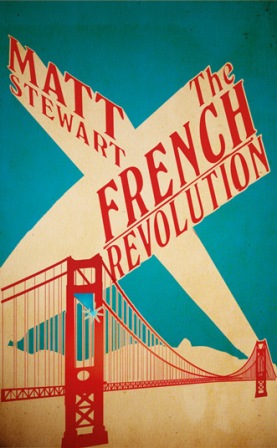
fr5

Denise thought that she would like the cover to have an image of the Golden Gate Bridge with a guillotine. As soon as people stop asking for drawings of sinister men with mustaches I get a bit nervous that I’m out of my element, so I took a long time to draw the bridge, even though I wanted to keep it two-dimensional for the moment. Shading it realistically was beyond the scope of my powers so I really hoped this one would languish on the vine before revealing my inability to do anything realistic.

fr6

Personal favorite! I drew the little grandma and then executed her with a paper cutter, then taped it over some red paper to be vaguely bloodish (but trying to keep it very physical, more as if it were violence against an illustration than a violent illustration) Denise was now keen to the bridge idea, they wanted to add some fog and to give it a sinister San Fran feel.

fr7

In desperation, I tried using a wide array of Photoshop effects to shade the bridge for me, but they really couldn’t help me out.

fr8

Instinctively returning to my last place of safety and comfort, I cut up the illustration and added some wild evil eyes looking down on the city, trying to rip off Rodrigo Corrall’s beautiful cover for The Savage Detectives. The French Revolution is also a book above all about these cartoonish, almost surreal characters, in that sense I felt it would be a shame to have a cover without any humans on it to relate the strange and aggressive quality of the world. A single facial expression is the most versatile and meaningful image, and figuring out one that is appropriate can make up for a great lack of technical ability… I liked this one as well.
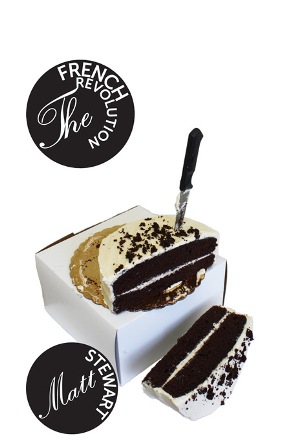
fr9

Thank god! It was my birthday and at my day job they gave me a cake! So I got out my camera and started taking pictures of it in the hopes of wooing them back over to idea number 3. But, of course, nobody in the office thought to give me a little guillotine for my birthday, a much less observed tradition.
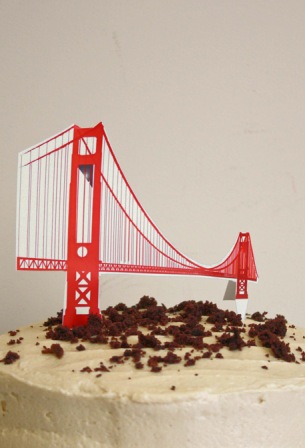
fr10

So I tried to print out the bridge and stick it on there, but that wasn’t working. So then I thought of the idea of executing the cake itself, much as I had done to the old woman. Alas, this was another death in vain and they wanted to see a more realistic bridge.

fr12

So then I sat there for a few hours redrawing the bridge and guessing what the shading would look like, I thought I was in over my head but it started to come together. “If you can’t do something well, do it meticulously” is the lesson, I guess.

fr13

They also wanted an image of San Francisco in the background. This wasn’t that hard as there was going to be fog, and as such the only building that would matter is the Transamerica pyramid anyways, so I figured i could draw it in Adobe Illustrator. I took a long time with it drawing in all the little squares for windows, as at this point I was committed to the deception of fooling them into thinking I had some technical ability.
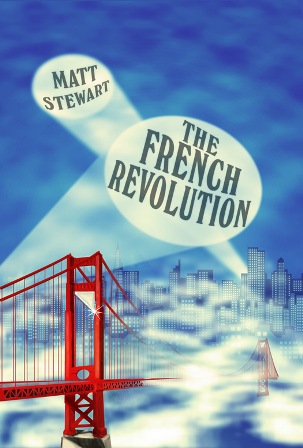
fr11

So then I added in some Batman style search lights. My thought was that the city of San Fran was calling out a frantic ‘S.O.S’, and then they were receiving one right back in exchange. It seemed like a good idea at the time, and I wanted to draw some silhouettes of a family of monsters attacking the city on the back, as I thought that would be adorable.

fr14

So nobody was game for the spotlights, but I didn’t want to have the title be straightforward, as then I would have nothing to distract people from the illustration, which by now looked absolutely horrible to me from having stared at it for so long and noticed all of its faults of perspective… So I cut up the font like it had been cut on the guillotine, thinking that might do the job.

fr15

And then Denise and Matt decided that the drawing was good enough and that I should just typeset it normally for the moment.