
Best Westerns

The Charlotte Observer ponders the legacy of William Saroyan, who was born 100 years ago in Fresno, California. Donald Munro writes: “Who can say why Saroyan doesn’t have the name recognition today of, say, his contemporary John Steinbeck?”

Funny you should ask! In today’s Washington Post, Jonathan Yardley joins Robert Gottlieb as a member of the Salinas Handwringers Society—a small but apparently growing group of critics who take whacks at Steinbeck’s works yet still find themselves enchanted by them. “Why do people still read Steinbeck today while his contemporary William Saroyan…is almost completely forgotten?” Yardley asks, then proposes an answer:

The only reason I can come up with for the high esteem in which Steinbeck is still held is his transparent sincerity. It has long been my pet theory that in the popular marketplace, readers instinctively distinguish between writers whose work draws on genuine feeling and those who rely on art or artifice, and that they reward the former while repudiating the latter. From Jacqueline Susann to Danielle Steel, from James Michener to James Patterson, readers have recognized the sincerity of feeling beneath the utter lack of literary merit, and have rewarded it accordingly.

Yardley isn’t being cute or glib here—his assessment is couched in a wise reading of Cannery Row, and the whole essay is worth your time.

Staying in the West a little longer: I’m a little out of practice in long-form reviewing, but I wanted a little more room than usual to discuss Rudolph Wurlitzer‘s The Drop Edge of Yonder and Willy Vlautin‘s Northline. My review of both novels is in this week’s City Paper.
Secretary, Take an E-mail

Larry McMurtry answers questions from LA Observed about his work via e-mail—or, rather, he has somebody type out his spoken answers into an e-mail:

Q: You’ve written that the media supplies memories. Are you saying that one’s personal memory of something isn’t real unless it is broadcast on TV or the internet? Do you think that the mania for taking pictures with cellphones and standing in public talking loudly on the phone is a way to take our memories back – create our own – star in our own stories, as obnoxious as that is for people standing behind the person on the phone? What are the consequences of all of this when it comes to the written word?

A: What I meant by the media supplying memories is that we watch movies, or television, and those things become part of our memory bank. We’ll have to wait and see what consequences these things will bring. I don’t know. Maybe no consequences. Maybe these things will eliminate the written word, but it’s unlikely. I don’t use a computer, nor go near the internet. In fact, Diana Ossana, my writing partner, is typing my spoken responses to your questions into her computer.

I call shenanigans on his claim that Heaven’s Gate is now considered a masterpiece, but otherwise there’s smart stuff in the whole interview.

Inside the Beetle Engine

Bloomberg News catches up with Samantha Hunt, author of The Invention of Everything Else, a novel about the final days of Nikola Tesla. (It’s a great premise that I wish was better executed.) The end of the conversation between her and Bloomberg’s Manuela Hoelterhoff:

Hoelterhoff: What drew you to Tesla?

Hunt: I never had heard about him through 20 years of an American education. And so, when I finally did stumble on him, I was quite surprised to learn that he had invented AC and the wireless.

And then I learned that when he was 8 years old, he created an engine that was powered by June beetles. And I thought, “Oh, boy, this man is so creative.”

He had plans to build a ring around the equator so that just by staying stationary, you would be able to travel around the world in 24 hours. And plans that almost seem like dreams. He was thinking about wind power, thinking about solar power, thinking about batteries that are far, far more efficient than the batteries that we even have here 110 years later. He had plans to photograph thought. He thought, well, thought is electrical energy, and we record electrical energy all the time. Why shouldn’t we be able to photograph it?

So What Else Is New?

Yesterday the National Book Critics Circle announced its latest Good Reads list—a selection of recently published books recommended by its members. Here’s the fiction list (links and formatting direct from the announcement post on the NBCC blog, Critical Mass):

1. Richard Price, LUSH LIFE, Farrar, Straus & Giroux
2. Jhumpa Lahiri, UNACCUSTOMED EARTH, Knopf
3. Steven Millhauser, DANGEROUS LAUGHTER, Knopf
*4. Charles Baxter, THE SOUL THIEF, Pantheon
*4. Peter Carey, HIS ILLEGAL SELF, Knopf
*4. J. M. Coetzee, DIARY OF A BAD YEAR, Viking
*4. James Collins, BEGINNNER’S GREEK, Little, Brown
*4. Brian Hall, FALL OF FROST, Viking
*4. Roxana Robinson, COST, Farrar, Straus & Giroux
*4. Owen Sheers, RESISTANCE, Nan A. Talese: Doubleday

You won’t have to look far to find somebody argue that this list is stuffed with the usual suspects. That’s a somewhat odd complaint to me, as somebody who spent a couple of years contributing to pop-music polls. I mean, of course these lists are filled with known names—they’re consensus-building exercises. Surprises, practically by definition, aren’t going to rise to the top. And I’m skeptical about consensus-building exercises in the age of the long tail. But something to keep in mind: When I attended a gathering at Politics & Prose a few months back to discuss the last batch of selections, many of the folks who attended found all this stuff surprising, and you don’t show up at Politics & Prose on a balmy Saturday afternoon to listen to book critics natter on unless you care about reading.

This time around, I suspect that most folks with even a casual interest in contemporary literature have heard plenty about Price and Lahiri, and anybody who makes writing about books part of their daily business is thoroughly sick of the pair of ’em by now. That’s not to say that a list of books that a preponderance of critics cared about is valueless, though—if only for folks who might be curious about what critics care about, and transparency is always a good thing.

All that said, I’m an NBCC member, and I was mindful this time around about not being one more person boosting Lush Life—much as I love it, it doesn’t need any more help. My pick was Rudolph Wurlitzer‘s The Drop Edge of Yonder, about which more soon.

Impropriety

I had a good time reading Keith Gessen‘s ruminations about Jonathan Richman and being a Bostonian in the Guardian, which is more than I can say for extended portions his novel, All the Sad Young Literary Men, which I review in today’s Minneapolis Star-Tribune. (I didn’t get too far into the complex business of how the novel’s characters are largely drawn from Gessen’s life. That’s partly a function of the space allotted for the review, but it mainly speaks to my feeling that, while it’s nice to know if a novel is a roman a clef, the text ultimately is only as good as what’s in it. Ten years from now, you shouldn’t demand that a reader Google up all of this foofaraw in order to better appreciate a work, and any writer who thinks you should isn’t dealing fairly with his or her readers. Scott McLemee sagely addresses all this in his latest column for Inside Higher Ed.)

Anyway! Jonathan Richman! Gessen writes:

The Modern Lovers sounds as if it could have been made yesterday. The music is stripped of everything but the most essential rock instrumentation, and sometimes, as on “Pablo Picasso” (“Some guys try to pick up girls,” it begins, almost ominously, “and get called assholes. / This never happened to / Pablo Picasso. / He would walk down the street, / women could not resist his stare. / Consequently Pablo Picasso / was never called an asshole”) or “I’m Straight”, Richman is barely even singing. Between this and the lyrics, which are funny, self-effacing, often flat-out pleading, all traces of the rock god have been eliminated. I don’t know how much of this is attributable to the fact that John Cale, the VU’s visionary bassist, produced half the album in 1972, but most of it must have been there to begin with. The Modern Lovers is modern in the sense of being continuously modern, of having managed to fall out of time. It seems as if Richman is naked, and speaking directly and immediately to you.

On Deck

Nicholas Dawidoff, author of The Catcher Was a Spy, an intriguing biography of Moe Berg, has a roundup in the Wall Street Journal of five great works of baseball fiction. (David Carkeet‘s The Greatest Slump of All Time was news to me.) Sportswriters may be the last batch of journalists (who aren’t book reviewers) with an affinity for fiction. In the Saint Louis Post-Dispatch, Derrick Goold hunts for a model for Rick Ankiel, the Cardinals’ hot pitching prospect turned hot slugging prospect. Goold turns to Philip Roth‘s junky baseball satire, The Great American Novel:

There’s also the lesser-known Luke Gofannon, from The Great American Novel. Gofannon is the best player ever to hoist a bat for the Port Ruppert Mundys in Philip Roth’s classic sendup, and he’s described purposefully Ruthian:

The iron man came up in 1916 as a kid pitcher, and then played over two thousand games in center field for the Ruppert club, scored close to fifteen hundred runs for them, and owned a lifetime batting average of .372 — the fella who was the Mundys to the three generations of Rupe-it rootas! … In his prime, they’d give him a hand just for striking out, that’s how beautiful he was, and how revered.

Short Timing

Next Wednesday Marian Seldes and Sloane Shelton will read from Eudora Welty‘s short stories at New York’s Symphony Space; the reading will be recorded for NPR’s “Selected Shorts” series.

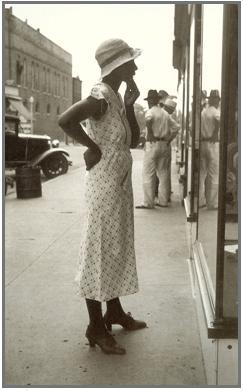
We’re in for a lot of Welty-related stories soon, given that next year marks the 100th anniversary of her birth. If you’re a Welty scholar, you’ve just missed the deadline to contribute to Mississippi Quarterly’s dedicated issue on her, but you have about another month to catch an exhibit of her photography at the Pearl Public Library. My one brief stop in Jackson a couple years ago was too brief for me to visit the Eudora Welty House (though I was there around St. Patrick’s Day and the town was fit to burst with Jill Conner Browne fans.) Visiting the house’s Web site reminds me that she was a fine photographer as a well as a great short-story writer; the Welty Foundation sells the photo you see here, Window Shopping, as a fundraiser for its efforts.

Squeaking By

Welcome to Little Rock, Arkansas, where the readers are enthusiastic, the fellas are big and lanky, and the shoes are squeaky. Tony Earley, author of the new The Blue Star, his likable sequel to Jim the Boy, read recently at the Arkansas Literary Festival; the Democrat-Gazette picks up the story (click on “print story” to avoid the registration nonsense):

So about midway through Mr. Earley’s reading, a big, lanky fella in the squeakiest shoes we’ve ever heard strolled through a door toward the back. Okay, so he was running late. Happens to the best of us.

Big, lanky fella then squeaked along all the way up to the front row. SQUEAK! Reading. SQUEAK! Reading. SQUEAK!

It was a good thing we’d already read the book, because we certainly couldn’t hear Tony Earley.

Then a cell phone rings….

Desperate Times Indeed

A musical adaptation of Margaret Mitchell‘s Gone With the Wind is getting a critical pasting in London. From the Timesreview of “this tuneless assault on the English language”:

And those songs! They began to scale the depths. Refrains included “Born to Be Free”, “These Are Desperate Times”, “The Wings of the Dove”, until the inevitable “Tomorrow Is Another Day”. This was cliché orchestrated in the hope it would make it less of a cliché. It merely magnified the assault on the language. And still there was not a memorable tune, a curious crime when the 1939 film had one of the greatest theme tunes ever, by Max Steiner. The original cast recording from this stage musical would be a gift for your worst enemy.

Vanessa Redgrave‘s performance in another British stage adaptation, of Joan Didion‘s The Year of Magical Thinking, is faring better with critics.